Get Free Ebook Cross-Platform Development in C++: Building Mac OS X, Linux, and Windows Applications
When I'm desired to read something, I intend to look up at certain book. Now, I'm still perplexed of what type of book that can aid me make desire of this time. Do you really feel the exact same? Wait, can everybody inform me just what to prefer to entertain my lonely and also free time? What type of publication is actually suggested? Such a difficult point, this is just what you and I possibly feel when having much more spare time and also have no suggestion to read.
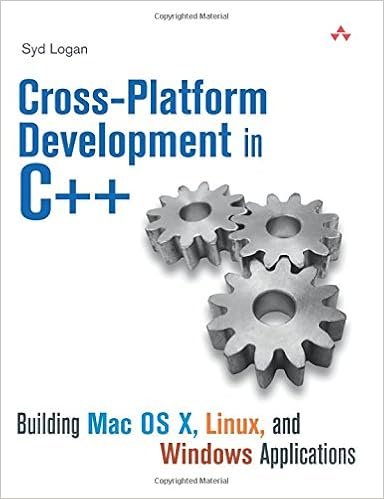
Cross-Platform Development in C++: Building Mac OS X, Linux, and Windows Applications

Get Free Ebook Cross-Platform Development in C++: Building Mac OS X, Linux, and Windows Applications
Don't make you really feel hard when searching for book that you will check out to spare your time. Book is always prominent in whenever, every era, and every age. All people will certainly require publication as recommendation to do something. When you have no suggestions about exactly what to do in this downtime, obtain Cross-Platform Development In C++: Building Mac OS X, Linux, And Windows Applications as one of the reference books that we supply! Offering unique books are so enjoyable for us. It is so very easy to offer compassion for everybody.
Nevertheless, this era also enable you to obtain guide from numerous resources. The off line publication store might be a common area to visit to get guide. Today, you can also locate it in the online library. This site is one of the on-line collection where you can locate your chosen one to check out. Currently, the here and now Cross-Platform Development In C++: Building Mac OS X, Linux, And Windows Applications is a book that you can find below. This book tends to be the book that will certainly give you new inspirations.
You can alter thing of how reading will give you much better option. Yeah, Cross-Platform Development In C++: Building Mac OS X, Linux, And Windows Applications is a book developed by a specialist writer. You can take this kind of publication in this site. Why? We provide the billions types as well as brochures of the books in the world. So, actually, it is not only this book. You can find other book types to be yours. The way is extremely straightforward, locate the link that we provide and also get guide sooner. Constantly try to be the initial individual to read this book is very fun.
Nowadays, the advanced modern technology constantly gives the amazing features of exactly how this book. Everybody will should obtain such certain reading product, about scientific research or fictions; it will rely on their perception. Occasionally, you will certainly need social or scientific research publication to review. Often, you need the fiction or literary works publication to have even more enjoyment. It will guarantee your condition to get more inspiration as well as experience of reading a book.
From the Back Cover
"Cross-Platform Development in C++ "is the definitive guide to developing portable C/C++ application code that will run natively on Windows, Macintosh, and Linux/Unix platforms without compromising functionality, usability, or quality. Long-time Mozilla and Netscape developer Syd Logan systematically addresses all the technical and management challenges associated with software portability from planning and design through coding, testing, and deployment. Drawing on his extensive experience with cross-platform development, Logan thoroughly covers issues ranging from the use of native APIs to the latest strategies for portable GUI development. Along the way, he demonstrates how to achieve feature parity while avoiding the problems inherent to traditional cross-platform development approaches. This book will be an indispensable resource for every software professional and technical manager who is building new cross-platform software, porting existing C/C++ software, or planning software that may someday require cross-platform support. Build Cross-Platform Applications without Compromise Throughout the book, Logan illuminates his techniques with realistic scenarios and extensive, downloadable code examples, including a complete cross-platform GUI toolkit based on Mozilla's XUL that you can download, modify, and learn from. Coverage includes Policies and procedures used by Netscape, enabling them to ship Web browsers to millions of users on Windows, Mac OS, and Linux Delivering functionality and interfaces that are consistent on all platforms Understanding key similarities and differences among leading platform-specific GUI APIs, including Win32/.NET, Cocoa, and Gtk+ Determining when and when not to use native IDEs and how to limit their impact on portability Leveraging standards-based APIs, including POSIX and STL Avoiding hidden portability pitfalls associated with floating point, char types, data serialization, and types in C++ Utilizing platform abstraction libraries such as the Netscape Portable Runtime (NSPR) Establishing an effective cross-platform bug reporting and tracking system Creating builds for multiple platforms and detecting build failures across platforms when they occur Understanding the native runtime environment and its impact on installation Utilizing wxWidgets to create multi-platform GUI applications from a single code base Thoroughly testing application portability Understanding cross-platform GUI toolkit design with Trixul
Read more
About the Author
Syd Logan is a software developer living and working in Southern California. A graduate of San Diego State University with B.S. and M.S. degrees in computer science, Syd was a member of the Netscape Client Product Development (CPD) team, where he held both engineering and management positions during the development of Netscape 6 and 7. After Netscape, Syd remained at AOL where he implemented VoIP and peer-to-peer video features as a member of the AOL Instant Messenger team. Syd’s previous publications include Developing Imaging Applications with XIELib and Gtk+ Programming in C (Prentice Hall, 1997 and 2001). His technical interests include machine learning, operating systems design, algorithms, and just about anything that has to do with C, C++, and Unix.
Read more
See all Editorial Reviews
Product details
Paperback: 576 pages
Publisher: Addison-Wesley Professional; 1 edition (December 7, 2007)
Language: English
ISBN-10: 032124642X
ISBN-13: 978-0321246424
Product Dimensions:
7 x 1.2 x 8.9 inches
Shipping Weight: 1.8 pounds (View shipping rates and policies)
Average Customer Review:
3.6 out of 5 stars
5 customer reviews
Amazon Best Sellers Rank:
#2,479,294 in Books (See Top 100 in Books)
To be honest this one of the few technical computer books I've read from cover to cover. I usually just use them for reference. On the subject of cross platform development this is currently the best and most up-to-date however there were a few areas I would have liked to seen covered better most notably the build environment and makes. Mr Logan does touch on these subjects but they are not given as much focus as I would have like to have seen which is why I'm taking one star away. With that said if I was asked to recommend a book on cross-platform development it would be Syd Logan's, hands down..
Logan tackles a lot of little complications that are the bane and reality of programmers writing multiplatform C++. This is not a book about learning C++ from scratch. Conceptually, it helps to think of this book as about 1 level above writing C++ code. For example, it discusses compiling, linking and running, where needed libraries might be missing.The book describes 3 platforms. Microsoft Windows, Macintosh and unix/linux. Strictly, the Macintosh is nowadays using a unix variant. But it's done differently enough, and the Mac is popular enough, that Logan stands it separate from other unix/linux environments.Perhaps the best recommendation of the book is to use a platform abstraction library. So that you can far more easily maintain a common code base. The suggested choice of library is NSPR. One simple way that it helps is in how it makes explicit the byte lengths of various C/C++ variables. This legacy C ambiguity is still with us, and causes much porting pain. It is no accident that newer languages like Java and C# make these definitions explicit. But many of us still have to write in C and C++.
This was a good book to reference and augment your C++ portability skills. I have been porting code for years and found a few nuggets in this book I did not have to find out through trial by fire.As a previous reviewer mentioned, it does not cover Java or C#/Mono, which by the name of the title makes sense. Java and C#/Mono are good tools, but if you need to be where the metal meets the meat and need the squeeze out all your MIPS you can, you'll have to move down the language hierarchy to C++ and assembly.By setting up a nice abstract layer and firewalling you system calls and platform dependencies, you can usually build quite large sustainable C++ cross platform frameworks on many systems without the need for a VM level language.
i like it
This book is utterly worthless. One of the greatest differences in developing for one operating system versus another is how libraries are handled. This topic isn't even covered by this book. Save you money.
Cross-Platform Development in C++: Building Mac OS X, Linux, and Windows Applications PDF
Cross-Platform Development in C++: Building Mac OS X, Linux, and Windows Applications EPub
Cross-Platform Development in C++: Building Mac OS X, Linux, and Windows Applications Doc
Cross-Platform Development in C++: Building Mac OS X, Linux, and Windows Applications iBooks
Cross-Platform Development in C++: Building Mac OS X, Linux, and Windows Applications rtf
Cross-Platform Development in C++: Building Mac OS X, Linux, and Windows Applications Mobipocket
Cross-Platform Development in C++: Building Mac OS X, Linux, and Windows Applications Kindle

No comments:
Post a Comment